
- Creating and Publishing a Form
- Conversational Form
- Create Multi Step Forms In WordPress
- Using Calculations in SureForms: A Step-by-Step Guide
- Calculation Formula Guide
- SureForms Login Block – Step-by-Step Guide
- SureForms Registration Block – Step-by-Step Guide
- SureForms – PDF Generation Feature
- GDPR Compliant Forms
- Create WordPress Forms With Conditional Logic
- Adjust Form Notification Emails
- Form Confirmation
- Entries Management Feature Guide
- How to Add Query Parameters to Form Redirects
- How to Fetch Query Parameters from URL
- Set the “From Email” in SureForms
- Setting Up “Reply-To” Email Using Form Input Tags – SureForms
- Restrict Form Entries in SureForms
- Form Scheduling in SureForms
- Conditional Confirmations in SureForms
- How to Connect Your Stripe Account with SureForms
- How to Connect PayPal in SureForms
- How to Create a Payment Form in SureForms
- SureForms Payments
- How Refunds Work in SureForms Payments
- Understanding Payment Processing Fees
- How to Display the Payment Dashboard on the Frontend (SureForms)
- Enable One-Time Payment and Subscription in a Single Form
- SureForms Integration with ActiveCampaign
- SureForms Integration with AgileCRM
- SureForms Integration with Airtable
- SureForms Integration with LatePoint
- SureForms Integration with FluentCRM
- Connect SureForms To Zapier
- WordPress Forms with the Custom App Builder
- SureForms Integration with Telegram
- SureForms Integration with Breeze
- SureForms Integration with Brevo
- Unable to Upload SureForms ZIP: File Unzipped On Download
- Browser Support for SureForms
- Not Getting Update Notifications
- How To Rollback to Previous SureForms Versions
- Publishing Failed: Invalid JSON Response
- Troubleshooting Email Sending In SureForms
- SureForm Submissions Marked as Spam – How to Fix
- API Request Failed – Nonce Verification Error
- Fixing the “Destination folder already exists” Error When Installing SureForms
- How to Set Up SureForms with Caching Plugins
- srfm_enable_redirect_activation
- sureforms_plugin_action_links
- srfm_quick_sidebar_allowed_blocks
- srfm_integrated_plugins
- srfm_suretriggers_integration_data_filter
- srfm_form_submit_response
- srfm_enable_gutenberg_post_types
- srfm_languages_directory
- srfm_form_template
- srfm_disable_nps_survey
Migrate Contact Form 7 Forms to SureForms
SureForms includes a built-in Migration feature that allows you to import existing forms from Contact Form 7 and convert them into SureForms forms. This makes it easy to move your forms without having to recreate them manually.
Before You Begin
Make sure that:
- SureForms is installed and activated.
- Contact Form 7 is installed and contains the forms you want to migrate.
- You have administrator access to your WordPress website.
Step 1: Open the Migration Tool
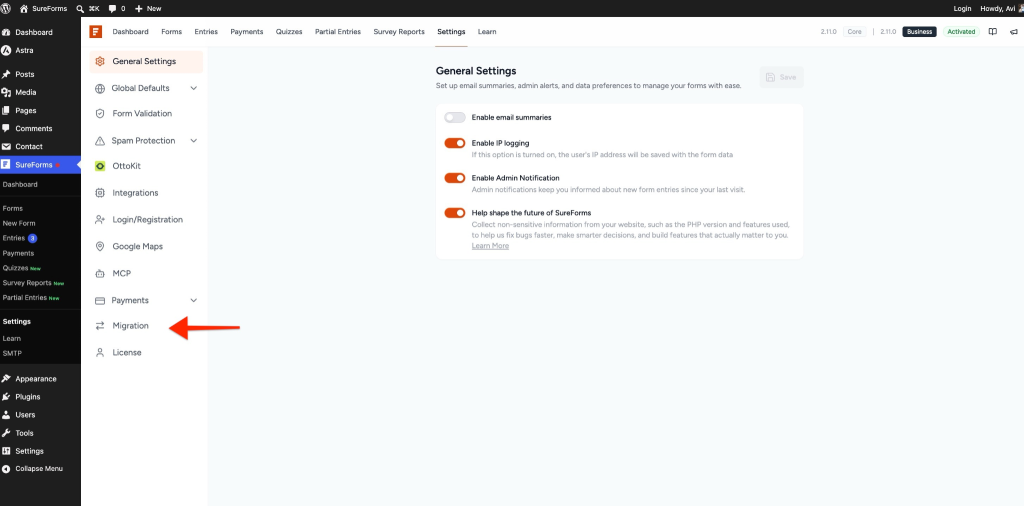
- In your WordPress dashboard, navigate to SureForms > Settings.
- Click on the Migration tab.
Step 2: Select Contact Form 7
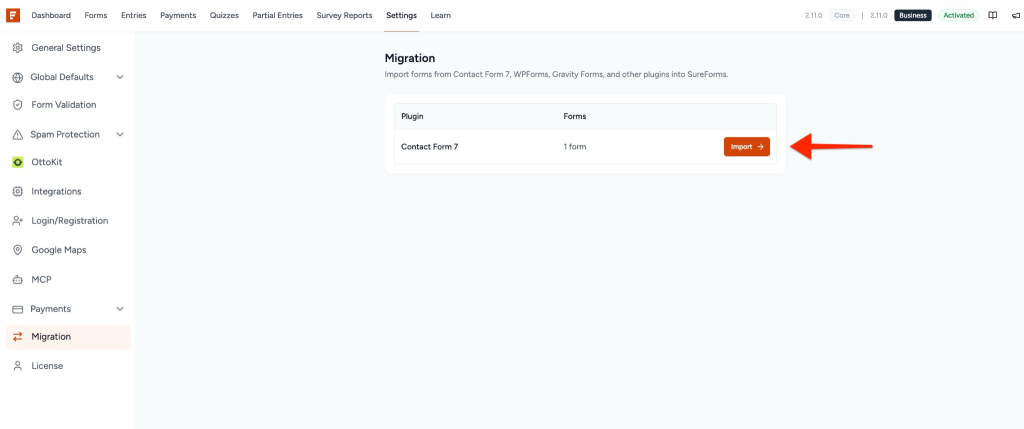
On the Migration screen, SureForms automatically detects supported form plugins installed on your website.
You will see:
- The plugin name
- The number of forms available for migration
Locate Contact Form 7 and click the Import button.
Step 3: Choose the Form to Import
After clicking Import, a list of available Contact Form 7 forms will be displayed.
- Select the form you want to migrate.
- Click Preview Import.
![Preview Import option]](https://sureforms.com/wp-content/uploads/2026/06/image-22-1024x539.png "Migrate Contact Form 7 Forms to SureForms")
Step 4: Review the Import Preview
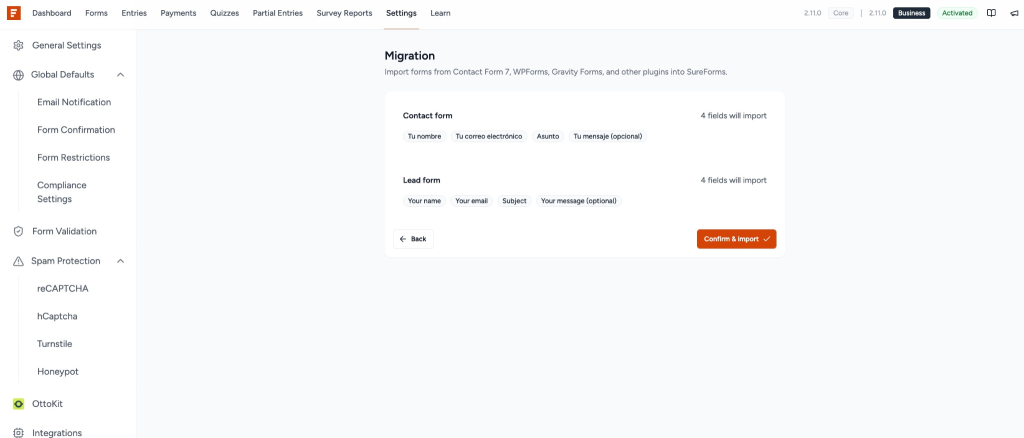
The preview screen displays the fields that will be imported into SureForms.
Review the form structure carefully and ensure that all required fields are listed.
Once satisfied, click Confirm & Import.
Step 5: Edit the Imported Form
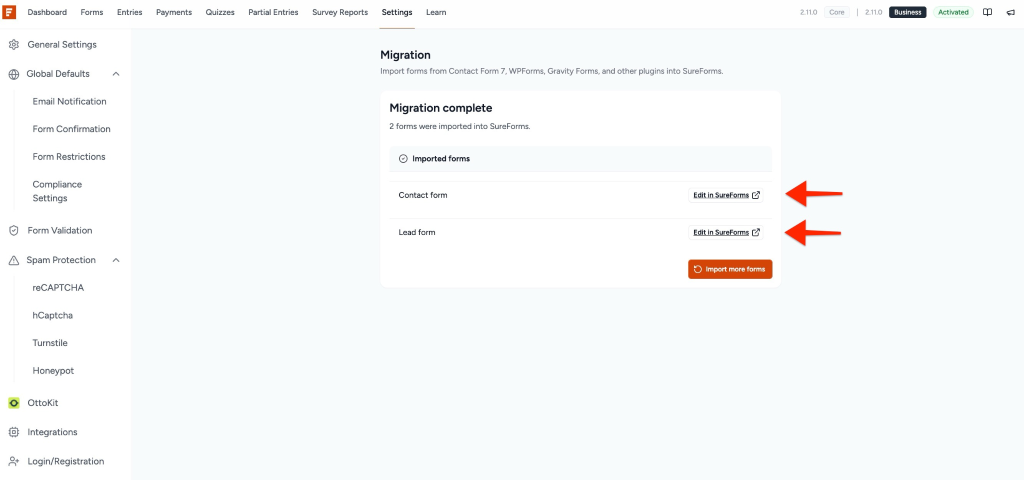
After the import is completed, SureForms creates a new form based on the Contact Form 7 form.
Click Edit in SureForms to open the imported form.
Step 6: Review Form Settings and Configurations
Although SureForms migrates the form fields automatically, it is important to review all settings after the import.
Check the following:
- Form fields and labels
- Email notifications
- Form confirmations
- Hidden fields
- Conditional logic (if applicable)
- Custom configurations
- Integrations and automation settings
Review Smart Tags Carefully
Different forms of plugins use different smart tags and merge tags.
After migration, review all smart tags used in:
- Email notifications
- Confirmation messages
- Custom field mappings
- Integrations
Some Contact Form 7 tags may require manual adjustment to match SureForms’ smart tag format.
For example:
- Contact Form 7 tags may differ from SureForms tags.
- Custom fields added manually in Contact Form 7 may need to be reconfigured.
Failure to update unsupported tags could result in missing values in emails or integrations.
Step 7: Publish the Form
Imported forms are created in Draft mode by default.
Before publishing:
- Review all fields and settings.
- Test the form submission process.
- Verify email notifications and confirmations.
- Confirm that all smart tags are working correctly.
Once everything has been verified:
- Publish the form.
- Embed it on your website using your preferred embedding method.
Recommended Post-Migration Checklist
After migration, we recommend:
- Review all imported fields
- Verify email notifications
- Check smart tags and merge tags
- Test form submissions
- Verify integrations and automations
- Review confirmation messages
- Publish the form
- Embed the form on your website
Troubleshooting Tips
If something does not appear as expected after migration:
- Review the imported field mappings.
- Reconfigure any custom Contact Form 7 settings manually.
- Verify that all smart tags are supported in SureForms.
- Test the form before making it live.
This ensures your migrated form functions exactly as intended after the transition to SureForms.
We don't respond to the article feedback, we use it to improve our support content.