
- Creating and Publishing a Form
- Conversational Form
- Create Multi Step Forms In WordPress
- Using Calculations in SureForms: A Step-by-Step Guide
- Calculation Formula Guide
- SureForms Login Block – Step-by-Step Guide
- SureForms Registration Block – Step-by-Step Guide
- SureForms – PDF Generation Feature
- GDPR Compliant Forms
- Create WordPress Forms With Conditional Logic
- Adjust Form Notification Emails
- Form Confirmation
- Entries Management Feature Guide
- How to Add Query Parameters to Form Redirects
- How to Fetch Query Parameters from URL
- Set the “From Email” in SureForms
- Setting Up “Reply-To” Email Using Form Input Tags – SureForms
- Restrict Form Entries in SureForms
- Form Scheduling in SureForms
- Conditional Confirmations in SureForms
- How to Connect Your Stripe Account with SureForms
- How to Connect PayPal in SureForms
- How to Create a Payment Form in SureForms
- SureForms Payments
- How Refunds Work in SureForms Payments
- Understanding Payment Processing Fees
- How to Display the Payment Dashboard on the Frontend (SureForms)
- Enable One-Time Payment and Subscription in a Single Form
- SureForms Integration with ActiveCampaign
- SureForms Integration with AgileCRM
- SureForms Integration with Airtable
- SureForms Integration with LatePoint
- SureForms Integration with FluentCRM
- Connect SureForms To Zapier
- WordPress Forms with the Custom App Builder
- SureForms Integration with Telegram
- SureForms Integration with Breeze
- SureForms Integration with Brevo
- Unable to Upload SureForms ZIP: File Unzipped On Download
- Browser Support for SureForms
- Not Getting Update Notifications
- How To Rollback to Previous SureForms Versions
- Publishing Failed: Invalid JSON Response
- Troubleshooting Email Sending In SureForms
- SureForm Submissions Marked as Spam – How to Fix
- API Request Failed – Nonce Verification Error
- Fixing the “Destination folder already exists” Error When Installing SureForms
- How to Set Up SureForms with Caching Plugins
- srfm_enable_redirect_activation
- sureforms_plugin_action_links
- srfm_quick_sidebar_allowed_blocks
- srfm_integrated_plugins
- srfm_suretriggers_integration_data_filter
- srfm_form_submit_response
- srfm_enable_gutenberg_post_types
- srfm_languages_directory
- srfm_form_template
- srfm_disable_nps_survey
How to Display the Payment Dashboard on the Frontend (SureForms)
You can easily display the payment dashboard on the frontend of your website using SureForms. This allows users to view their payment history and manage subscriptions.
Method 1: Using the Block Editor (Gutenberg)
If you are using the default WordPress block editor, follow these steps:
Steps:
- Edit or create a page where you want to display the payment dashboard.
- Click on the Add Block (+) button.
- Search for the Payment History block.
- Add the block to your page.
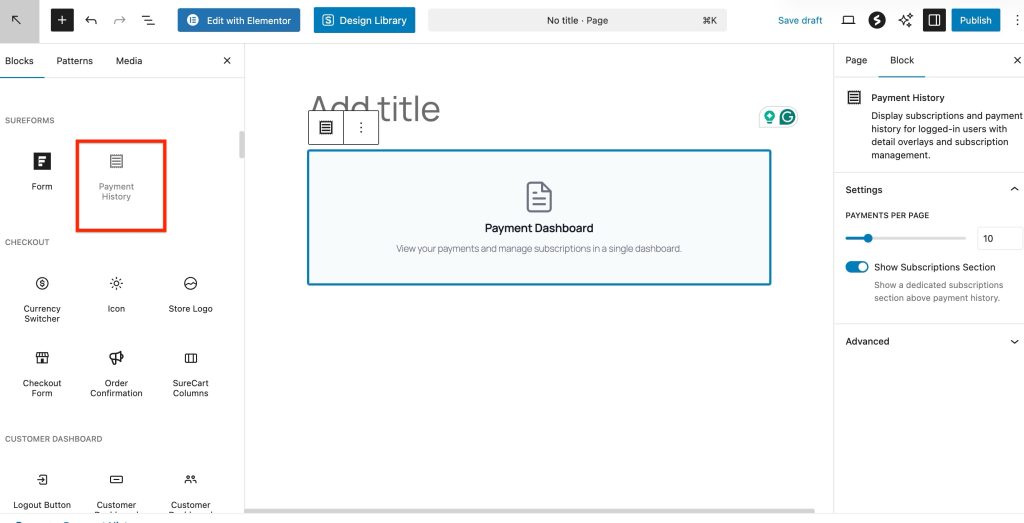
Block Settings
Once you add the block, you will see the following options:
- Payments Per Page
Set how many payments you want to display per page. - Show Subscription Section
Enable this option to display subscription details.
Frontend Output
After publishing the page, users will be able to:
- View their payment history
- See details such as:
- Form Name
- Payment Type
- Payment Gateway
- Transaction ID
- Manage subscriptions:
- Cancel subscription
- Keep active subscription
Method 2: Using Shortcode (For Page Builders)
If you are using a page builder (like Elementor, Beaver Builder, etc.), you can use a shortcode.
Default Shortcode:
[srfm_payment_history]This will display all payment history on the frontend.
Shortcode with Parameters:
[srfm_payment_history per_page=10 subscription=true]- per_page – Number of payments to show per page
- subscription – Enables subscription section
Was this doc helpful?
What went wrong?
We don't respond to the article feedback, we use it to improve our support content.